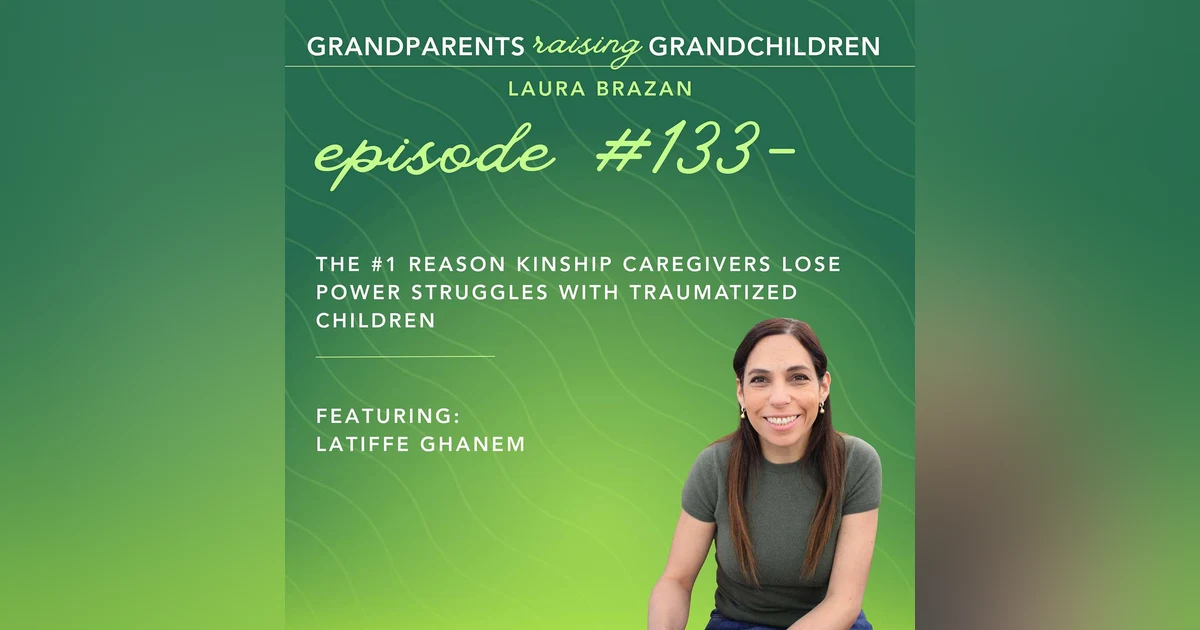
The #1 Reason Kinship Caregivers Lose Power Struggles With Traumatized Children


Key Takeaways
- Traumatized children often lash out with hurtful words, but kinship caregivers must view this behavior as information rather than taking it as a personal attack.
- Parenting and caregiving do not create your reactive stress patterns; instead, they simply bring your deep-seated triggers to the surface.
- Lati Ganem emphasizes that every emotion a child feels is entirely valid, but not every behavior is acceptable or permitted.
- Caregivers should avoid trying to reason with a dysregulated child in the middle of an emotional storm, comparing it to trying to teach someone how to swim while they are actively drowning.
- Releasing the burden of perfectionism allows grandparents and kinship caregivers to lead with a steadier hand and a calmer heart, recognizing that good is good enough.
Are you a grandparent who finds yourself thrust into parenting once more, often on short notice and without a clear roadmap? Do you wake up exhausted, tending to children who have walked through trauma, while your own dreams and routines fade into the background? Are you longing for steadiness amid the emotional storms—conflicts, diagnoses, behavioral challenges—that seem to erupt daily in your household? The strain of kinship caregiving, coupled with personal loss or change, can feel endless and isolating, especially when old wounds and perfectionism rise to the surface.
I’m Laura, and like many of you, I never expected to be leading a second family in this season of life. Navigating complicated family histories, the heartbreak of loss, and the friction of daily caregiving, I’ve discovered that my patterns of stress and autopilot weren’t created by parenting—they were simply exposed. The journey of raising my husband’s grandchildren has pushed me to confront deep-seated beliefs about control, resilience, and what it means to lead with grace.
Welcome to ‘Grandparents Raising Grandchildren: Nurturing Through Adversity.’ On this podcast, we explore the unique journey of kinship caregivers. You’ll hear honest conversations with those who know this path, as well as practical tools from trauma experts like Lati Ganem to help you identify and regulate your triggers, hold boundaries with empathy, and model healthy leadership at home. We don’t promise perfection—just a supportive community where your struggles, victories, and hopes are understood and valued.
Join us as we rewrite the future for our families—one grounded, courageous step at a time—and discover that, together, we are not just a safety net, but the solution.
New! Grandparents Raising Grandchildren Online Support Circle! Starting Wednesday, October 7th, we meet every other Wednesday from 12:30 PM to 2:00 PM Eastern.
A peer-first, confidential space—free from cross-talk, judgment, or unsolicited advice. Guided by certified therapists, specialized family coaches, and counselors who truly understand kinship care.
When we look at the child welfare system today, it’s clear that the framework we've inherited is completely outdated. We keep trying to "fix" programs, but what if the problem isn't just funding or execution? What if the problem is how we frame the issues in the first place?
Ali Caliendo, founder of the Kinship Policy Lab, reminded us that the questions we ask determine the policies we write, the data we collect, and the outcomes we pursue.
I want to know how you’re doing. Is the podcast giving you what you need? What support are you missing most right now? Send me a Direct Message on Facebook or Instagram or email me directly at laurabrazan@grandparents-raising-grandchildren.org. I read and reply to every message because this community is built on supporting each other!
Thank you for tuning into today's episode. It's been a journey of shared stories, insights, and invaluable advice from the heart of a community that knows the beauty and challenges of raising grandchildren. Your presence and engagement mean the world to us and to grandparents everywhere stepping up in ways they never imagined.
Remember, you're not alone on this journey. For more resources, support, and stories, visit our website and follow us on our social media channels. If today's episode moved you, consider sharing it with someone who might find comfort and connection in our shared experiences.
We look forward to bringing more stories and expert advice your way next week. Until then, take care of yourselves and each other.
Want to be a guest on Grandparents Raising Grandchildren: Nurturing Through Adversity? Send Laura Brazan a message on PodMatch, here: https://www.podmatch.com/hostdetailpreview/grg
Liked this episode? Share it and tag us on Facebook @GrandparentsRaisingGrandchilden
Love the show? Leave a review and let us know!
CONNECT WITH US: Website | Facebook
"We are more than a " - Laura Brazan
Frequently Asked Questions
Why do kinship caregivers lose power struggles with traumatized children?
Caregivers often lose power struggles because they take the child's hurtful remarks personally and react from an emotional place, effectively dropping down to the child's level instead of remaining the regulated adult in the room.
How can trauma-informed expert Lati Ganem suggest handling a child's explosive meltdowns?
Lati suggests waiting until the child is calm and feels safe before trying to communicate, noting that reasoning with a dysregulated child is ineffective because they are operating out of a neurobiological fight, flight, or freeze response.
What is the best way for grandparents raising grandchildren to overcome perfectionism?
Grandparents can overcome perfectionism by abandoning the expectation of a flawless household, accepting that life with traumatized children is inherently unpredictable, and embracing self-compassion when they fall short.
00:00 - Overview of Podcast Topics
00:00 - Handling conflicts in relationships
06:07 - Managing emotional triggers and reactions
09:46 - Raising my step-grandchildren
12:14 - Dealing with hurtful children remarks
18:03 - Parenting and managing expectations
20:26 - Handling conflicts in relationships
22:04 - Discussing societal norms and parenting
29:55 - Embracing Unconditional Child Worthiness
32:39 - Supporting Middle-Income Families
34:14 - Managing Child Behavior Triggers
Handling conflicts in relationships
SPEAKER_01Lati Gonam spent over 15 years helping high-powered business leaders stay steady under pressure. Today she uses that expertise as a trauma-informed coach to help kinship caregivers realize that the same stress and quick-to-react patterns we see in professional settings often show up in our living rooms too. We're leading a vital mission to protect the children in our care, but we can't lead effectively if we're constantly exhausted and reacting to every spark. Today Lati is helping us look at what triggers our stress so we can lead our families with a steadier hand and a calmer heart, rather than just feeling like we're constantly putting out fires. Welcome to Grandparents Raising Grandchildren, Nurturing Through Adversity. In this podcast, we will delve deep into the challenges and triumphs of grandparents raising grandchildren. As we navigate the complexities of legal, financial, and emotional support, I invite you to join us on a journey of exploring thoughts, feelings, and beliefs surrounding this growing segment of our society. Drawing from real stories and expert advice, we will explore the nuances of child rearing for children who have experienced trauma and offer valuable resources to guide you through the intricate journey of kinship care. We'll discuss how we can change the course of history by rewriting our grandchildren's future, all within a supportive community that understands the unique joys and struggles. This podcast was made especially for you. Welcome to a community where your voice is heard, your experiences are valued, and your journey is honored. Welcome back to the boardroom, everyone. I'm going to be completely transparent with you today. Parenting, just like leadership, doesn't create our reactive patterns, it just brings them straight to the surface. Raising my grandchildren has been one of the most difficult things I've ever faced, and I've faced quite a few. Between navigating complex diagnoses, past family trauma, and the daily friction of unexpected caregiving, there are days where I find myself operating on pure autopilot just to survive the week, as I'm sure you do too. I used to think I was in control of my life, but stepping into this role in the second cradle forced me to face many old hurts and my own perfectionism. Today's guest gave me a profound shift in perspective. Lati Ganam brings her rich background in corporate leadership and trauma coaching to help us understand the neurobiology behind these triggers. She reminds us that when our kids act out, it's not a personal attack, it's information to be used. This conversation gave me some practical tools that I am using to stop fighting with my inner child, hold firm boundaries with grace, and step into more grounded leadership. Welcome to the show, Lati. It's okay I call you Lati, right?
SPEAKER_00Yes, yes, that's it. Okay. Thank you so much for having me, Laura. Thank you so much.
SPEAKER_01It's a pleasure. Your background is amazing, and I think it's wonderful that you've come to work with people that have experienced trauma, families and individuals, because it isn't unlike the corporate world that you dealt with before. And parenting, just like leadership, doesn't create our reactive patterns, you say. It just brings them to the surface, which I have found to be true. So many of us that are raising our grandchildren just have become worn down by these battles, not just with the system, but with the kids in our own families. Oftentimes we find ourselves in sort of an autopilot mode, just trying to survive, survive the day, survive the week, survive the month. I'm excited to have you share with us as grandparents how we can use these same tools of emotional regulation that you have taught in corporate leadership to help us stay calm, stay grounded, and complete our missions here at home raising these
Managing emotional triggers and reactions
SPEAKER_01grandkids.
SPEAKER_00Well, I think the most important thing, Laura, is you got you guys have to give yourselves a lot of grace and a lot of compassion, a lot of love, a lot of light, because it is a beautiful mission, but it comes with a lot of work and it comes with a lot of grief in terms of grieving for the life that you thought you were gonna have, grieving for the life that you currently have in a way, and then showing up every day for that little kid or that teenager or that young adult that is now needing again a parent, and essentially filling that role of parenting all over again. So, how do you regulate yourself? You start by really understanding what triggers you and how those triggers get activated. Because when we react on autopilot, we really react from a neurobiological standpoint. We don't react from our thinking brain or our, you know, it's not, it's not that we are thinking the process through and we're reacting through that. We are reacting neurobiologically because we are either in fight, flight, or freeze. And those three uh components are the way that our body has trained us or our brain has trained us to react when we see danger. So depending on how you've been raised or what coping mechanisms you've used in the past, how those coping mechanisms have been ingrained in you, you go to either one of these three patterns. You either fight because you are in fear of losing control, and you get angry and you become very explosive, you become either like my way or the highway, you know, you become a freezer where it's like you can't deal with conflict and uh you're going to just freeze in place and not really understand what's going on, and sort of just let the children rule the roost, so to speak, or you flee. And a lot of the you guys in the situation that you're in, you are very familiar with this because the the children that have now absconded their role as parents, the situation is so scary to them, or it's so insurmountable to them that they have literally fleed their role as parents. And that's either because they have trauma of their own or because they feel like they're going to mess up their children, or because they're not mature, they're not ready. So many reasons that we have to, but now you're sort of stepping into that role. So I'm not obviously excusing the reaction. I'm just letting you, it's it is a neurobiological response. So the first thing is that we need to understand how that gets triggered in us and then work on those triggers internally to be able to show up with calm and confidence.
SPEAKER_01Most of us have faced difficult situations, but I think probably this is one of the most difficult things that I've faced. I lost a child tragically, and that was very, very hard. Of course, it it's hard every day, but these children are alive, and every day I face conflict with them. I never really understood how I handled conflict until I was put in this situation. It causes issues in my marriage I wouldn't have had otherwise. My husband and I basically met after he lost his wife, and I'd finished raising my children as a single mother. So we chose the life we had together. It was really kind of problem-free in a lot of
Raising my step-grandchildren
SPEAKER_01ways. Yeah. But this is more difficult than raising my children the first time around. And as I mentioned, these children are not my biological grandchildren. But of course, I married my husband. And when his son couldn't handle the responsibility of raising his children, and their mother wasn't able to because she was incarcerated, then I inherited the problem. So I'm I having to identify old issues, old hurts that I didn't even have in my life until now. So I do understand why that's so important. Now, one thing that's become been very difficult for me also is, and I even mentioned this to my husband the other day, and and it's what I'm going to be working with this week with my counselor, is that these kids act out for all different kinds of reasons. Some that are biological behavior issues that they cope with, some of them are still out of trauma. Even though it's been five years, we probably will be dealing with some of these issues for the entire time that we raise these kids. But I see them oftentimes as personal attacks. Instead of seeing it in a way that makes me look at what's wrong, I'm going to use my granddaughter as an example. My granddaughter has dyslexia, severe dyslexia. She also has a cognitive issue with her brain because her mother did meth and utero. She also was recently diagnosed with schizophrenia and bipolar, which her mother, who just got out of jail for the fourth time, admitted that she was diagnosed with as well. She does not communicate the way my kids do. She doesn't react the way my kids do. How help me with that? How do we do that with these kids?
SPEAKER_00Yeah. Well, first of all, it is a lot to deal with because she not only has, you know, the trauma of what she experienced and how she experienced life from a very young age, but then she also has real life issues that she was going to need support with in terms of school and being able to succeed. The first thing I would take her behavior a lot as information. We tend to look at the reaction of children when they say, I hate you. You're not my mom. Don't tell me what to do. I don't ever want to see you again. Um, and these are very common words that children say all the time. You're
Dealing with hurtful children remarks
SPEAKER_00not my mommy. The other day I was talking to one of the moms I work with, and her son told her, you have two choices. You can either jump off the window or leave this family forever. Um, so children can be really cruel, right? And and and if you take that to heart, if you take their words to heart, you can end up being in a power struggle with them because you feel you're hurting me, I'm gonna hurt you back. You're hurting my ego, my sense of self, everything. And that's when most parents go into look at everything I do for you. Look at, and this is how you treat me, this is how you speak to me. But you have to understand the child doesn't have the skills, the emotional development, or the ability to communicate the way you have. You're the adult at the end of the day. So you can't be pulled back into being that inner child, into into going into your child's self and fighting with the child that's in front of you. You have to be sort of more having like an adult self saying, this is not real. What they're saying right now is just frustration, anger, it's emotional overload. They don't have the skills to communicate, but I'm gonna teach them. And I think I mentioned it to you before. I think every emotion is valid, not every behavior is valid. And I think that's what we need to teach children. You are entitled to your emotion. You can be angry, you can be upset, you can be sad, you can be frustrated. Of course, you're entitled to feel all those things, but you're not entitled to hurt people just because you feel them. So I'm gonna teach you how to deal with your emotions. I'm gonna guide you. But the way to teach them is to maintain emotional regulation yourself. So that the trick here is not to solve, fall into the quote unquote trap of falling into their emotion or their reaction as a personal attack to you, but really saying, okay, they're dysregulated right now.
SPEAKER_01And so what what can we, what are what should our extra.
SPEAKER_00It's like if someone is drunk, it's like if you have a drunk best friend and you're trying to reason with them. Nobody would try to reason with your drunk best friend, right? Everybody would just say, okay, I'm gonna wait until she sobers up and then I'm gonna talk to them. It's the same thing I tell parents. Imagine that your child is is drowning and you're trying to teach them how to swim right there and then. It's impossible. Nobody's listening at that point. They're drowning, you're flailing, you're trying to teach them, and you're like, wait, do this, but this. It's like nobody's listening. You have to wait until the person feels safe to be able to communicate.
SPEAKER_01So you're saying we should, we may have to do this many times over and over and over, every time they're drowning in whatever their emotional issue is. So our expectation cannot be, we can't really have expectations from what you're telling me. Yes. We we can repeat, and there's some consequence for behaviors after a certain point of time. But I know that with a lot of these kids, they have to be taught these things over and over and over many times.
SPEAKER_00Every child, there's a lot of boundary holding, and boundary holding is very tough for parents because it's um uncomfortable, right? When you're saying you can't have more ice cream, and the kid is melting down and throwing a fit, most parents end up giving in because they're like, okay, fine. What's the thing? What do you do? Do you walk away? Do you suggest walking away or I suggest you say, you know, yeah, I already told you there's no boundary. That's my boundary. I told you there wasn't gonna be any more ice cream, and you're gonna shout and y and yell. But if they get their way, if eventually they get their way, they know that eventually you're going to you're going to move on your boundary. You don't have to scream or yell or threaten if you just hold the consequence and you say, I told you if you did this, or I I explained that there wasn't going to be any additional ice cream, I think that's what's important to to really think about. Uh-huh.
unknownYeah.
SPEAKER_01Well, I always felt before this that I was in control of my life before I got these kids. So one of the things I noticed that finding the balance between being the capable woman in control that I felt before I was overwhelmed, like I feel today sometimes, or like I felt yesterday. Yeah. But we want to identify as leaders. We're trying to identify as leaders of our families without feeling guilty when we fall short of our own expectations and things aren't perfect. I have to say, I'm kind of a recovering perfectionist. And I think many leaders are, probably always, right? Yes. So maybe uh I imagine, well, what what how do you help people like us, recovering perfectionists, cope with this situation?
SPEAKER_00Well, I think the first thing is to understand that there's no such thing as perfection, and there's no such thing as a perfect child. And the moment you you leave that expectation on at the door where you're thinking, if I just do the XYZ, this is going to be the outcome. And you're sort of doing things in return for or expecting that this is what the outcome is going to be. And if there's anything that life has taught you right now, is that no matter how great you plan and no matter how great you do things, life is full of the unexpected and it's full of surprises that you never knew. Because, like you said, you didn't expect to be here.
Parenting and managing expectations
SPEAKER_00You probably thought that you had done everything right, that you had already raised your children, you married your husband, and suddenly you're you're back, you know, at a face in your life that you thought had been done, completed. And I think the first thing is we need to leave that expectation at the door that our children are going to be perfect, that we are going to do something or magically have the magic, the potion, or or create the perfect movie so that our children will come out with X, Y, Z. I think you have to live day by day. You have to show up day by day, and you have to understand that some days are going to be tougher than others. And give yourself the understanding that, you know, it's going to be tough and it's going to be hard and it's not always going to be perfect. And sometimes good is good enough because you can't expect things to always be, you know, A plus, because you also don't want to set this unrealistic level of expectation to the children that you're raising, because that's not real either. And they are modeling your behavior. You have now become their leader, you have now become their parent. So if you have this unrealistic level of perfection for you, guess what? You're you're also passing that down to the children that you're raising.
SPEAKER_01I find that one of the most important things that I need to remember is that I'm able to model differently every day that I learn to these kids. You know, they're amazing. Children are amazing. We think we've done so much damage when we fail one day. And then the next day, I learn insight that helps me go back to them and say, you know, this is what I've been doing wrong. I think I've been expecting a lot of you. And let's look at the realities of what you can cope with and what you've learned and what your background is. I'm gonna hold you as to a certain level of behavior. But but and that's my job as your grandmother and your mother now. But I'm gonna learn to to handle this a little bit better next time. And they just they forget the past so easily. They forget how you failed. They remember, I think, more importantly, your ability as a leader to be transparent.
Handling conflicts in relationships
SPEAKER_00Yes, yes. They will always remember that you showed up and they will always remember repair and being and saying, you know what, grandma didn't handle that great. And it's okay. Because you didn't handle this great. And how can we handle this better next time as a unit? So the next time you have a meltdown, grandma can do this, but hey, the next time you feel frustrated, isn't it better that you don't scream and shout at grandma instead do XYZ? Because that's what creates the real connection. Because every relationship is going to have conflict. Every relationship. We can't pretend that no relationship is ever going to be, you know, unicorns and rainbows, and we're all going to get along and we're all going to hold our hands. You're going to have conflict with your children, you're going to have conflict with your parent, with your partner, you're going to have conflict with your grandchildren. But the important thing is how do we repair that conflict? How do we come back from it? And then how do you model that moving forward?
SPEAKER_01As as a child myself that grew up in a broken family, these children, and I remember saying this myself, think that there are all these other families that are perfect families. Yeah, everybody else's family is a perfect family. And I have so much joy in telling them we are not the perfect family, but we are our family. This is our family. This is who we are. Exactly. And and I love that we're a little crazy. I call it crazy good. You're a little crazy, grandma. I go, yeah, well, I call it crazy good. And I think you're crazy good too.
Discussing societal norms and parenting
SPEAKER_00I love that because it makes it, you know, it makes it special. Because how do we how do we define what's normal? How do we define what's right? How do we define what's what's acceptable? And I think because we are raised in a culture where societal norms have really taken over of what is correct, what is right, what is success, what is happy, what is good, what is a traditional family. We have to be more open-minded and more flexible, especially with these children that you you are raising, because they can't feel like they are missing out. I mean, they're all there's always gonna be a part of them that comes from the trauma that knows that mom and dad didn't show up for them. And that's something that they're gonna have to deal with, like the abandonment of that, or why weren't they good enough? But if they have strong caregivers in their life that tells them, you didn't really miss out. This is what you got. Look at what you got instead. Look at what you got instead. This is because we tend to think, you know, I've had parents, you well, you were a single mom. I've had parents that say, you know, I couldn't, my husband was abusive, or my husband, so I would I and I said, We tend to believe that if you don't have mom, dad, children, the children are somehow missing out on having, you know, that nuclear family. But isn't it better to have one strong parent than having two dysfunctional ones? Yes, yes.
SPEAKER_01Right? Yes, absolutely. Well I want to share with the audience your program. Let's of course. Let's talk about you because you're amazing. You're thank you. You're I'm so excited about your program, Breaking the Power Struggle.
SPEAKER_00Yeah.
SPEAKER_01Tell us a little bit about that. What would you say is maybe one survival tool in your program that could help a caregiver or an advocate interrupt this reactive cycle in real time, whether it's the kids or the system?
SPEAKER_00I think the most important thing we touched upon earlier, which is that wound and the trigger. So when when our when the trigger, when we see our children triggering a wound that we have, we focus on that instead of seeing it as communication or or information. And I think with breaking the power struggle, the important thing is that we don't focus on the child's behavior. We focus on the parent. We focus on how is it that you are tra how is it that you can show up? How is it that what what is really impacting you as a person so that then you can show up as a leader, then you can show up confidently because you are not getting dragged into quote unquote the mud by the emotional part, but you are regulated enough to say, okay, I understand where this is coming from. I'm not going to engage right now. The child is dysregulated. I have to be regulated.
unknownGreat.
SPEAKER_00And there's no such thing. Exactly. And there's no such thing as perfection. We're not going to be 100% regulated all the time. Sometimes we, you know, sometimes somebody's going to cut us off in the street and we're going to honk back and be like, you know, it's no, no such thing as perfection. There's no such thing as 100% in control, 100% regulated. But it does give you the tools to be more self-aware. And I think that's what's important.
SPEAKER_01Why don't you tell the listeners where they can find out more about your community and your insights, Lati?
SPEAKER_00Sure. So they can find me on my website. It's called www.livinginprogress.com. Obviously Living in Progress, because I believe we're all works in progress. We're all learning every single day. And then they can also find me on Instagram at living in underscore progress. And in the website, if they're interested, they can take a free parent pattern quiz, which just shows them a little bit of the pattern that sometimes runs the show with their kids and how they can break that pattern with a little micro shift and really help them develop that those skills and that confidence they need to be leaders in their families. And with their tiny humans. Yes.
SPEAKER_01Yes. I love it. As you know, I'm getting ready to publish a book and I've been asking all of those that I interview three questions, three basic questions. One is a systematic question, one is a taboo question, and one is a policy question. So the systematic question I have for you, we find that systems want us to follow rules. But as leaders of our families, and all of our families are so unique and individual, I find that the real goal that we have is learning how to raise these individual children. We're trying to find out who is the child. Each child is individual. So we have to change the rules for every child. How do we manage that desire that we fight to be obedient to the systems instead of focusing on building our homes, these unique individuals in these unique situations, so that everyone feels calm and everyone feels hurt?
SPEAKER_00I think that the most important question is why do we feel we have to be obedient in the first place? Why do we have that ingrained in our own belief system that obedience is the key to happiness? And who are we being obedient to? Like we are at the end of the day, the rule setters of our own life and our own family. And what works for your family, only you know. So who are you trying to be obedient to? And I think that's the bigger question. We we lived in a world that teaches us that cultural norms are the end all be all, right? But who says who? We are we get to make the rules and we get to really understand that, you know, your child's needs
Embracing Unconditional Child Worthiness
SPEAKER_00are different than your neighbor's child's needs, and that's fine. That's okay. But each child comes with their own beauty and their own purpose in life. And being able to say, you are worthy just because you are, and not you are worthy just because you perform or because you excel or because you succeed, I think that is the key. That is what we really need to change in ourselves as parents. Being able to say, you are worthy just for being here, and I love you just for being here, and not make it have like a conditional.
SPEAKER_03Mm-hmm.
SPEAKER_00Very good.
SPEAKER_01The taboo question I have for you is that we we don't often talk about how hard it is going from being these confident, capable human beings and professionals to feeling lost in this chaos of a broken legal system or a child's trauma. How do we handle the shame of feeling like we're failing just because we don't run perfect households 24-7?
SPEAKER_00Yeah, I think, you know, we all carry a little bit of shame because we all feel, and I you touched upon this earlier. We all think the family next door has the perfect family, and and Susie next door is, you know, she bakes cookies every day, and she is there for every soccer practice, and I'm late, and I always have to buy cookies for the bake sale. And I think comparison is the enemy of joy. When we are constantly comparing ourselves to somebody else or to some ridiculous standard that we have set for ourselves, when when we fall into perfectionism or when we fall into people pleasing and we fall into this imposter syndrome where we think we are not good enough, that's when we really feel like that failure is coming for us. And I think the first thing is really understanding that self-love and self-empowerment and that building your self-esteem to understand that you are enough, you are worthy, and that you don't have to measure up to anybody else's expectations. There shouldn't even be any expectations because it's really about showing up every day and just doing the best you can. Yes, I agree. Thank you.
SPEAKER_01The policy question. If you were in charge of the country, what is the first thing you would change to make sure that grandparents have the emotional support and the stress management tools that they need, not just checklists to lead their families well?
SPEAKER_00Yeah, I think I mean there's so many things that I would love to provide, but I think the most important thing among them
Supporting Middle-Income Families
SPEAKER_00is financial support and counseling services. I would love to be able for caregivers to have access to financial support because middle income families suffer so much in the system where we are right now. I personally also suffered. Like it's not you're not poor enough to get this, but you're not rich enough to afford that. So you're sort of in the sandwiched in between, and you don't have the resources you need for your family. And I think that's something that I would definitely make more accessible for families everywhere, financial support for middle-income families and you know, services, counseling services, offering them more, even creating like support groups. I think there's a lot of support groups for parents, but there's not a lot of support groups for grandparents. I mean, and I would love to maybe explore this with you eventually, maybe creating like a coaching group for grandparents where we can come together and they can share experiences and we can talk about it because there's a lot of groups for parents that are like, oh, my toddler is going through this and this is the faces, but how are how could we create that for grandparents? Then maybe we can explore that together.
SPEAKER_01Yeah, it's a great idea. Thank you, Lati. Thank you so much for being on the program. I love what you do and I appreciate all of your expert wisdom.
SPEAKER_00Thank you so much for having me. I loved being here, and I can't wait to read your book. Thanks.
SPEAKER_01Talk to you soon. Talk to you soon. Step into the reflection room with me. Let's take a deep breath together and let go of the unrealistic expectation
Managing Child Behavior Triggers
SPEAKER_01of perfection. Ask yourself honestly today, where are you getting pulled into a power struggle because you're viewing a dysregulated child's behavior as a personal attack? Remember what Lati shared with us. Every emotion is valid, but not every behavior is acceptable. I say this to myself and the kids all the time now. You're the adult in the room, and you don't have to be 100% regulated all the time. Good is good enough. I challenge you this week to identify one recurring trigger in your home. And when the storm hits, don't try to reach them, don't try to teach them how to swim while they're drowning. Wait for the calm, hold your boundary without yelling, and embrace your family for exactly who you are. We are not the perfect family, but we are our family, and that is crazy good. We are the silent army changing the narrative. More than a safety net, we are the solution. Keep nurturing, keep leading, and I'll see you in the next boardroom.